photo ea8ce356-0b08-49b7-86a8-097fec8d74bb_zpssrpsdstx.jpg

Search Mirror Dance


Eleanor_Cowper

Visit Us on Facebook

Facebook Page
 

Seekers

Seekers
by John Bucknall

Seekers


Through this forest of dreams bathed in leaf -dappled light,
we seek the Dreamweaver for his help with our plight.
We follow the herald, proud stag of pure white,
and pray that we find the Dreamweaver tonight.

Dreamweaver, Dreamweaver, weave starlight for us
into bright dreams of silver, wrought out of love.

Since the flame of the Guardian has diminished in power
our dreams too have darkened, doom laden and sour.
May the stag guide us true to your magical tower,
and your light melt the shadows from our darkening hour.

Dreamweaver, Dreamweaver, shield our troubled minds
from his arrows of fear and his darkness that binds.
Before nightmares stampede through the gates of our minds,
weave your spell of protection ‘til your tower we find.

Hold back the dark one and grant us the time
to come to that haven where beacons still shine.
Dreamweaver, Dreamweaver, we at last see your light;
until dawn’s new awakening, please guard us this night.

* * *


John Bucknall is a 54 year old civil servant working in the historical and sometimes hysterical city of Coventry. He's very married with two daughters who are meant to be grown up. He says he should have named his youngest daughter "Boomerang" because no matter how many times he throws her out she keeps coming back and emptying his fridge.

John maintains he has the mental age of a twenty-year-old but unfortunately his body is closer to a seventy-year-old’s, mainly because he still behaves like a twenty-year-old when his wife lets him get away with it.

A confirmed Terry Pratchett fan, John is a mine of useless Discworld trivia and if he ever gets onto "Who Wants To Be A Millionaire?" would like the million pound question to be something like "What's the name of Death’s horse?" Obviously all the preceding questions would need to be on the Discworld as well.

What inspires you to write and keep writing?

My inspiration comes from writing. Faced with a blank page, I start to write. I never know where the journey will take me. Stephen King said it best; "The only way to write is to write and hope you fall through the hole in the page."

The Chintzy Carpet

The Chintzy Carpet
by Michael A. Kechula
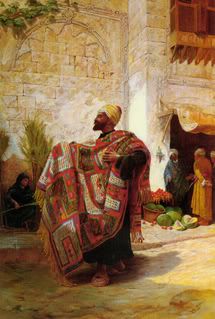
Chintzy Carpet


One evening in the year 1938, as Winston was stuffing a dead German spy into a Lisbon back alley garbage can, a Portuguese barmaid stepped outside for fresh air. She screamed and ran back into the bar before he could shoot her with his silenced pistol. After hearing his report, the British station chief ordered Winston to disappear in the Casbah of Tangiers until things cooled down

Winston hurried to the Lisbon Aerodrome to catch the night flight to Tangiers. While waiting for the eight-passenger, Ford Tri-motor airplane to depart, he decided to pass the time in the small, terminal cafe. The moment he entered, he scanned the room to see if any of the several dozen patrons were German agents. None of the faces matched any he’d memorized from dossier photos.

After downing two scotches, Winston was approached by an Arab wearing a business suit.

“Begging your pardon, Sir. You are English, no?”

“Yes, I’m English,” Winston sniffed, while checked to see if anyone was looking his way.

“Permit me to introduce myself. I am Abu Yacob Ben Wadi, recently of Cairo. Now, sadly, a resident of Lisbon.”

“Harry Ingram, London Times.”

Appearing nervous, the Arab wiped perspiration from his forehead with a grimy handkerchief. “If I may get directly to the point. Due to a slight misunderstanding, the police have confiscated my passport. Thus, I cannot leave Lisbon. But, I must get something to my son in Tangiers. You are going there, no?”

“Possibly.”

“If so, perhaps you will deliver a parcel to my son. I am willing to give you this magnificent, two-carat ruby ring for your kind assistance. See how it catches the light?”

“A ruby to deliver a parcel? No thanks. I’m not interested in carrying contraband across any border. Not for a ruby ring, or all the gold in the Bank of England.”

“You misunderstand, Sir,” Ben Wadi said, wiping his forehead again. “Not contraband. A family heirloom. A small carpet.”

“The post office offers reliable service. Certainly, they’d welcome your business, and charge far less than the price of a ruby ring.”

“I do not trust the mail. This is worth far more than you can imagine. Let me show you.” The Arab opened a case and removed a thin, chintzy carpet the size of a bath towel.

Winston had seen similar junk in bazaars all across North Africa. Why was delivering something so cheap and common worth a ruby ring? But those were strange times. Jews were giving fortunes for train rides to flee Nazi-held territories. And now Arabs were giving rubies for carpet deliveries.

“I will not withhold the truth,” Ben Wadi said. This is a very unusual carpet. If one says, ‘rise carpet,’ it obeys. When one climbs onto the carpet and says ‘go carpet,’ he is taken anywhere in the world, in seconds.”

“Perhaps you should use it to leave Lisbon and visit your son.”

“I cannot. One is allowed to ride only thrice in a lifetime. Alas, I’ve used all three. But my son can use it for transport to South America. War is near. Europe, Asia, and Africa will not be safe. But the great ocean will keep South America safe. There, he will prosper. Here he will die. Please sir, take this carpet to him. Allah will bless you.”

“How do you know I won’t steal your carpet?”

“Allah would frown on such a monstrous sin, and send a thousand djinn to punish you severely.”

This man’s a loon. On the other hand, if I agree to deliver his crummy carpet, I’ll be the new owner of that expensive-looking ring.

Winston asked for the son’s address, took the ring and carpet, and boarded the plane.

The next morning, he put the carpet in a satchel and caught a cab. When he arrived at the blighted apartment building near the waterfront, he found the young Arab’s quarters empty. Neighbors said he’d moved a week ago. Nobody knew where. Winston shrugged and headed back to his seedy hotel room in the heart of the Casbah.

That evening, while puffing an after dinner cigar in a shabby café, Winston felt eyes penetrating his back.

Turning, he saw an androgynous face of indeterminate nationality sitting with three thuggish-looking brutes.

“Mister Ingram. Are you enjoying Tangiers?” a voice purred in an accent he couldn’t place.

“I don't believe I’ve had the pleasure—”

“Do not play games. I know what you have. I want it.”

Winston chuckled. “You’ve mistaken me for someone else, Miss, uh, Sir. My name is Archibald Palmer. I have nothing of value, except my collection of African locusts, which is not for sale.”

When the scowling goons reached inside their jacket pockets. Winston raced for the door. Jumping into a taxi, he headed for the Casbah. Certain they were following him, he switched cabs three times and gave drivers large tips for driving at breakneck speed through Tangiers’ narrow streets. When he was certain his evasive tactics had worked, he returned to his hotel.

After a hot shower, he listened to BBC news on a battered radio. Prime Minister Chamberlain had just returned from Berlin. “Peace in our time,” he told applauding masses after signing a peace treaty with Hitler.

Winston scoffed. He’d read highly secret intelligence reports about Hitler’s global ambitions. He’d also read Winston Churchill’s speeches in the London Times, that warned against British complacency and appeasement policies. He agreed with Churchill that another European war was looming. He figured once it began, there'd be no safe haven for anyone in Europe, or Africa—especially intelligence agents. He knew that once war was declared, his life expectancy would be reduced to zero.

I’m getting too old for this, he murmured. The last war was horrible enough. If our intelligence is correct, Hitler’s planning a war that’ll make the last one seem like a bloody Boy Scout picnic.

He found himself wishing he were on the other side of the world on one of Tahiti’s majestic beaches. Gentle Pacific breezes. Lovely Polynesian maidens. Peace and quiet. No Germans. No war. No espionage—ever again.

Someone knocked softly. “Mr. Ingram,” said the voice from the café, “we have a business proposition.”

Dammit! How the hell did they find me?

Grabbing a pistol, he pressed against a wall near the door. “I told you my locust collection is not for sale.”

“Locusts do not interest us. We want the carpet. Just open the door slightly, pass it through, and you won’t be harmed.”

“What bloody carpet?”

“The one the Arab gave you. Before we killed him. The carpet that flies.”

Who are they trying to kid? Something must be sewn inside that thing. Maybe it’s filled with diamonds. Maybe Ben Wadi’s a jewel thief, or deals in stolen gems. Why else would they threaten me over a chintzy carpet? “How much are you willing to pay?”

“We’re not buying. We wish to trade. In trade for the carpet, we’ll spare your life.”

He wondered about the odds of a shoot-out. Even if he survived, he risked arrest, interrogation, identification. All hell would break loose among the twenty nations who jointly administered Tangiers, if they discovered his true occupation. They’d probably label him a dangerous provocateur, and charge him with instigating a destabilizing, international incident. If they didn’t hang him, he’d rot in a stinking North African prison.

“I don’t have the carpet,” he called.

When they began to pick the lock, Winston felt panic rising. There was no way out, except through the window. But lack of a fire escape meant a four storey fall.
He figured he only had seconds left before they’d charge into his room. His mind raced. Then he remembered what the Arab said in the café about the carpet’s magical properties. Desperate, Winston threw the carpet on the floor and shouted, “Get me the hell out of here!”

Nothing happened.

Dammit. What are the right words? He visualized the scene with the Arab and remembered Ben Wadi had used the words, “Rise carpet.”

The moment Winston said those words, the carpet levitated a few feet. Amazed, he grabbed his valise, climbed aboard, and yelled, “Go carpet!”

Instantly, Winston was hurled through the windowpane.

Seconds later, the door burst open.

While goons searched the hotel room, an Englishman rolled up a carpet and tucked it under his arm. Whistling “Rule Britannia,” he strolled among coconut palms along a peaceful, moonlit beach.

* * *


Michael A. Kechula is a retired technical writer. His flash and micro-fiction tales have won first prize in six contests and honorable mention in three others. His stories have appeared in ninety-four online and print magazines and anthologies in Australia, Canada, England, and US. He’s authored a book of flash and micro-fiction stories: “A Full Deck of Zombies--61 Speculative Fiction Tales.” eBook available at www.BooksForABuck.com and www.fictionwise.com Paperback available at www.amazon.com

What inspires you to write and keep writing?

I've been writing fiction only six years. Prior to that, I made my living as a professional writer of self-study textbooks and task-oriented instructional manuals for industry. By switching to fiction, I've found new outlets for my unquenchable urge to write. Frankly what inspires me to keep on going is the fact that I've been able to get an average of 1.7 stories accepted per week for thirty-seven months straight. During that time, my work has been accepted by ninety-four print and online magazines and anthologies in England, Canada, Australia, and US. With that kind of success and continuous reinforcement, the impetus to write even more is quite powerful. If my fortunes were suddenly reversed, and my work was constantly rejected, I'd write anyway. Perhaps it's a compulsion. But it's the o ne of the most rewarding compulsions anybody could hope for.

"A Time To...Volume 2: The Best of the Lorelei Signal 2007"

“A Time To… Volume 2: The Best of the Lorelei Signal 2007,” edited by Carol Hightshoe
Reviewed by M. Arkenberg

Now in its second year, The Lorelei Signal is a quarterly webzine dedicated to featuring strong female characters in works of Fantasy. Editor Carol Hightshoe, whose 2006 anthology A Time To…Volume 1has been named as a finalist for the 2008 EPPIE award for fantasy and nominated for the celebrated Tiptree award, now brings together the best short stories and poems of The Lorelei Signal’s 2007 edition in A Time To…Volume 2.

A Time To...2


Opening the anthology is Samantha Henderson’s “Cinderella’s Funeral,” an elegantly executed poem with a surprise ending. After the early death of her Prince, Cinderella goes from a fur-slippered princess to a warrior queen. Henderson presents potent imagery and wastes no words in doing so; this poem makes a powerful statement with its unique take on the fairy tale and is the perfect opening for a strong and varied collection.

Next from the January issue is “Ellette’s New World,” a coming-of-age story by Gene Stewart. After her mistress is killed in battle, Ellette must find her own way in a world that seems determined to hold her back. Dedicated to the memory of Marion Zimmer Bradley, this story would not feel out of place in one of MZB’s popular Sword and Sorceress collections. Ellette is beautifully characterized, an intelligent, resourceful woman the reader can sympathize with. If this story has any fault, it is in the occasional awkwardness of the prose—“a small nod bobbed her head once”—but overall, Stewart’s work is original and attention-grabbing.

Justin Staunchfield gives us “Portrait of the Artist in Manganese and Copper Oxide,” a wonderful combination of what-if’s and observations. On an expedition to Terran Analog 17, Teri Rozan has an encounter that will change her views on art and life forever. Though more science fiction than fantasy, this story is well-written with engaging characters and many surprises. With his excellent dialog and realistic details, Staunchfield brings Teri’s world—and her journey of personal discovery—to life. This story is truly magnificent, and one I will enjoy rereading.

The best of the January issue closes with “The Witch’s Revenge,” by Barbara Davies. This story provides a superbly witty and readable sequel to Hans Christian Andersen’s “The Tinder Box,” following the unfortunate witch Trudel (who lost her head in Andersen’s original tale) as she goes on a journey to reclaim her grandmother’s tinder box. Trudel is an original character readers will enjoy getting to know, and Davies provides her with an ending that I will only say is far more satisfactory than the original.

“Harleys in Driftwood,” by C.A. Casey, opens the best of the April issue. When the quiet artist Tara decides to display her unique driftwood sculptures to the public, her work has a startling affect on its viewers. Though not as strongly speculative as the other works in the anthology, Casey’s story is original and entertaining. The artist Tara will remind readers of many an eccentric friend, and I can guarantee you will never look at driftwood the same way again.

Next is the beautiful “Her Sheltering Wings,” by Elizabeth Barrette, a common name on the Lorelei Signal’s table of contents. Barrette’s work balances powerful imagery with a poignant exchange between lovers; it is at once inspirational and heartbreaking, and one of my personal favorites from the anthology.

Linda Epstein’s “Kaserie’s Choice” begins with the age-old formula of a female dressing as a male to escape confinement (in this case, slavery), but by the end of the story, no one would mistake it for a conventional fantasy. Epstein’s careful world-building comes through in a multitude of details, and Kaserie’s moral dilemma at the end is finely presented. The story might benefit from a few paragraphs being cut from the beginning, but from the moment the Seeker is introduced, the revelations and surprises are perfectly paced. I hope to see more of Kaserie and her world in future issues of the Lorelei Signal.

“Retirement” from Lindsey Duncan takes a unique approach to fantasy warriors in the form of Taris, a sixty-two year old knight looking to spend her retirement raising horses in her childhood village. But will she spend it alone? Duncan’s smooth, original descriptions give this flash fiction a strong sense of place, and the unexpected ending is well presented.

Closing off the April issue is B. A. Barnet’s chilling “Second Moon.” Governor Falev has murdered his brother and taken his beautiful wife, Aritei, for his own; but the spell that keeps Aritei’s will subdued has also affected her mind. This story combines human, believable characters with strong pacing and powerful irony. Aritei’s character is the perfect blend of beauty, innocence and mystery, and readers will cheer her triumph with the intoxicating feeling that justice has been served.

Marva Dasef opens the best of the July issue with “A Visit to Potter’s Field,” the humorous story of Griselda, a not-so-recently deceased gypsy doomed to answer a question for whoever digs her out of her grave. Dasef’s wit and Griselda’s long-suffering tone provide a sense of light-heartedness between two of the darker pieces in the anthology; this is a story you can’t help but want to share with a friend.

Megan Arkenberg’s “Leanansidhe” (pronounced “lan-awn-shee”) poses the question, how far would you go for inspiration? This lengthy, tightly structured poem follows the speaker on a quest for Leanansidhe, the fairy muse of the Isle of Man, who demands a high price for her service. Arkenberg provides an interesting and original approach to the myth, though the poem’s 126 lines may be daunting to some readers.

Next comes “Mentor for Hire” from Gloria Oliver. When the alchemist Rees puts out an advertisement for her mentoring services, a babysitting job for the hyperactive Justinian Alfredo Sebastian Rockspear IV is not at all what she had in mind. Oliver combines strong characterization and witty description in a story that is both funny and heartwarming.

Elizabeth Barrette returns to close off the June issue with “Ngati and the Listeners,” the story of Ngati, Goddess of Little Voices, and the mischief she spreads among mortals. Whimsical and entertaining, this story encourages rereading, as well as a new excuse to add to the book; “Ngati made me do it!”

“Broken Vows” by J.C. Lee tells the story of Hippolyta, Queen of the Amazons, and the choices she must make between her promises to her husband, Theseus, and her kingdom, Lemnos. While drawing many of her characters and settings from Greek mythology, Lee provides them with personalities and motivations that modern readers will recognize from personal experiences. Hippolyta’s dilemma is well-present, and the story kept me guessing until the very end.

J. J. Fellows’s “Tempting the Fates” goes where few fantasy stories have gone before; into the weaving room of the Fates themselves, with Lilith and a bottle of wine. While the battle over the “traditional” role of women is frequently waged, the results in this tale were a very pleasant surprise. Fellows moves smoothly between the philosophical musings and Lilith’s ironic solution.

Next, Marva Dasef brings us “The Delegate,” a thought-provoking tale of a different kind of prejudice. While serving as a delegate at the World Congress, Nioba Kune encounters an android who will change her views on his kind and his world. While the terminology makes this story occasionally hard to follow, the wonderful conclusion is well worth the effort.

The final short story in the collection comes from Kapri Sanders. “The Unholy” follows a fast-paced debate between Olin and Endellion, a literary pair the reader is sure to quickly recognize. Sanders’s approach is both witty and original; the author made a wise choice in keeping the story brief and to-the-point.

The anthology closes with Jessica Wick’s lyric “Virgin and the Unicorn,” a new approach to the timeless myth. Wick’s imagery and powerful use of repetition make this a poem well worth rereading.

Overall, I was most impressed by the variety and consistent quality of the works in this anthology. A Time To…Volume 2 is scheduled for release on March 15 and will be available to purchase through WolfSinger Publications at lulu.com. The Editor’s other e-zine, Sorcerous Signals, will be releasing a “best of” anthology called Arcane Whispers in May.

For more amazing stories and poems, see
The Lorelei Signal’s current issue.

Arkenberg


Megan Arkenberg is a writer and poet from Milwaukee, Wisconsin. Her work has appeared in many webzines and anthologies, including The Lorelei Signal, Rose & Thorn, A Fly in Amber, and numerous haiku and tanka publications. Her story “Panthanatos” was included in Hadley Rille Books’ Ruins Metropolis anthology earlier this year. When not writing, she divides her time between music, painting and editing Mirror Dance.

What do you think attracts people to the fantasy genre?

I think writers and artists are attracted to the idea that nothing is out of bounds; no setting is too strange, no character too eccentric. We thrive off problem-solving as we find new ways for our characters to interact with their world and with each other.

Readers are attracted by humanity; they want to see interactions between real, human (in a broad sense) characters. Fantasy isn’t about escapism. It’s about discovering the fundamental pieces that make us human across all possible cultures and all possible worlds.